Solutions Architect Beginner to Expert
A roadmap for learning Solutions Architecture, from cloud fundamentals to advanced AWS design patterns, security, compliance, and scalable distributed systems.
This roadmap guides you from cloud fundamentals through to professional-level AWS solutions architecture. Each stage builds on the last, so get the foundations solid before tackling advanced networking, security, and architectural patterns. Use the AWS Well-Architected Framework as your guide throughout, and pair your learning with hands-on labs and real-world design exercises.
Cloud Computing Fundamentals
Cloud Service Models
IaaS, PaaS, and SaaS: what each model provides and who manages what.
Cloud Deployment Models
Public, private, hybrid, and multi-cloud deployment strategies.
CapEx vs OpEx
Understand the financial model shift from capital expenditure to operational expenditure.
Economies of Scale
How cloud providers pass cost savings to customers through massive infrastructure scale.
AWS Global Infrastructure
Regions & Availability Zones
How AWS Regions are composed of isolated AZs and why this matters for HA design.
Edge Locations & CloudFront PoPs
How AWS delivers low-latency content globally via its edge network.
AWS Local Zones & Wavelength
Extend AWS infrastructure to metro areas and telecom networks for ultra-low latency.
Choosing a Region
Criteria for region selection: latency, compliance, service availability, and cost.
AWS Identity & Access Management (IAM)
IAM Core Concepts
Users, groups, roles, and policies, the four building blocks of AWS IAM.
Principle of Least Privilege
Grant only the permissions that are required, and apply that to every identity.
IAM Roles & Assume Role
Cross-account access, EC2 instance profiles, and service-to-service permissions.
IAM Policies
Identity-based, resource-based, permission boundaries, SCPs, and session policies.
AWS Organizations & SCPs
Manage multiple accounts with AWS Organizations and restrict permissions with Service Control Policies.
Compute EC2 & Auto Scaling
EC2 Instance Types & Families
General purpose, compute-optimised, memory-optimised, storage-optimised, and accelerated computing.
AMIs & Launch Templates
Create golden images with AMIs and standardise instance config with Launch Templates.
Auto Scaling Groups
Dynamic and predictive scaling policies, cooldown periods, and lifecycle hooks.
EC2 Pricing Models
On-Demand, Reserved Instances, Savings Plans, Spot, and Dedicated Hosts.
Placement Groups
Cluster, spread, and partition placement strategies for performance and fault tolerance.
Compute Serverless & Containers
AWS Lambda
Function lifecycle, triggers, concurrency, layers, and cold start optimisation.
Amazon ECS
Task definitions, services, Fargate vs EC2 launch types, and cluster management.
Amazon EKS
Managed Kubernetes on AWS, with node groups, Fargate profiles, and add-ons.
AWS Fargate
Serverless container execution, with no cluster infrastructure to manage.
Storage S3 & Object Storage
S3 Core Concepts
Buckets, objects, keys, versioning, and the S3 consistency model.
S3 Storage Classes
Standard, Intelligent-Tiering, Standard-IA, Glacier, and Glacier Deep Archive.
S3 Lifecycle Policies
Automatically transition objects between storage classes or expire them.
S3 Security
Bucket policies, ACLs, Block Public Access, pre-signed URLs, and SSE options.
S3 Replication
Cross-Region Replication (CRR) and Same-Region Replication (SRR) for DR and compliance.
Storage Block, File & Hybrid
Amazon EBS
Volume types (gp3, io2, st1, sc1), snapshots, encryption, and multi-attach.
Amazon EFS
Fully managed NFS file system, with performance modes, throughput modes, and access points.
AWS Storage Gateway
Bridge on-premises environments to cloud storage with File, Volume, and Tape Gateway.
AWS Snow Family
Snowcone, Snowball Edge, and Snowmobile for offline data transfer at petabyte scale.
Databases Relational
Amazon RDS
Supported engines, Multi-AZ deployments, read replicas, and automated backups.
Amazon Aurora
Aurora architecture, Aurora Serverless v2, global databases, and cluster endpoints.
RDS Proxy
Manage database connection pooling for Lambda and highly concurrent applications.
Database Migration Service (DMS)
Migrate databases to AWS with minimal downtime using DMS and SCT.
Databases NoSQL & Caching
Amazon DynamoDB
Partition keys, sort keys, GSIs, LSIs, DynamoDB Streams, and capacity modes.
DynamoDB Design Patterns
Single-table design, access pattern modelling, and avoiding hot partitions.
Amazon ElastiCache
Redis vs Memcached, caching strategies (lazy loading, write-through), and cluster modes.
Amazon OpenSearch Service
Full-text search, log analytics, and OpenSearch Serverless for unpredictable workloads.
Networking VPC Fundamentals
VPC Core Components
Subnets (public/private), route tables, internet gateways, and the default VPC.
NAT Gateways & Instances
Enable outbound internet access for private subnets without exposing them inbound.
Security Groups & NACLs
Stateful security groups vs stateless Network ACLs, for layered network defence.
VPC Flow Logs
Capture and analyse IP traffic for security auditing and troubleshooting.
CIDR Planning
Design non-overlapping IP address ranges for future VPC peering and Transit Gateway.
Networking Advanced Connectivity
VPC Peering
Direct routing between VPCs, its limitations, transitive routing, and use cases.
AWS Transit Gateway
Hub-and-spoke network topology for connecting many VPCs and on-premises networks.
AWS Direct Connect
Dedicated private connectivity from on-premises to AWS, with use cases and resilience options.
AWS Site-to-Site VPN
IPSec VPN tunnels over the internet as a cost-effective hybrid connectivity option.
AWS PrivateLink
Expose services privately across VPCs and accounts without traversing the internet.
Load Balancing & Traffic Management
Application Load Balancer (ALB)
Layer 7 routing, host/path-based rules, weighted target groups, and WAF integration.
Network Load Balancer (NLB)
Layer 4 ultra-low latency load balancing, static IPs, and TLS termination.
Gateway Load Balancer (GWLB)
Deploy, scale, and manage third-party virtual network appliances.
Amazon Route 53
DNS routing policies: simple, weighted, latency, failover, geolocation, and multivalue.
Content Delivery & Edge
Amazon CloudFront
Distributions, origins, cache behaviours, TTL, signed URLs, and OAC.
CloudFront Functions & Lambda@Edge
Run lightweight logic at edge locations for request/response manipulation.
AWS Global Accelerator
Improve global application availability and performance using the AWS backbone network.
Architecture Design Principles
AWS Well-Architected Framework
The six pillars: Operational Excellence, Security, Reliability, Performance, Cost, and Sustainability.
Design for Failure
Assume components will fail. Build redundancy, retries, and fallback paths into every design.
Loose Coupling
Reduce dependencies between components to allow independent scaling and failure isolation.
Design for Scale
Horizontal vs vertical scaling, stateless design, and avoiding single points of failure.
High Availability & Disaster Recovery
RTO & RPO
Define Recovery Time Objective and Recovery Point Objective to guide DR architecture.
DR Strategies
Backup & Restore, Pilot Light, Warm Standby, and Multi-Site Active-Active patterns.
Multi-AZ vs Multi-Region
When to use AZ redundancy vs full region failover, and the cost vs resilience trade-offs.
AWS Backup
Centralise and automate backups across EC2, RDS, DynamoDB, EFS, and more.
Microservices & Decoupled Architecture
Microservices Principles
Single responsibility, independent deployability, bounded contexts, and API contracts.
Amazon SQS
Standard vs FIFO queues, visibility timeout, DLQs, and long polling for async decoupling.
Amazon SNS
Pub/sub messaging, fan-out patterns, and SNS filtering for event-driven architectures.
Amazon EventBridge
Serverless event bus rules, event patterns, pipes, and cross-account event routing.
Serverless Architecture
Serverless Design Patterns
Event-driven, fan-out, saga, and async request-response patterns with Lambda.
Amazon API Gateway
REST, HTTP, and WebSocket APIs, plus throttling, caching, auth, and usage plans.
AWS Step Functions
Orchestrate multi-step workflows with Standard and Express state machines.
AWS SAM & Serverless Framework
Infrastructure as code for serverless applications with local testing support.
Security Data Protection
AWS KMS
Customer-managed keys, key policies, grants, and envelope encryption.
Encryption at Rest
Enable server-side encryption for S3, EBS, RDS, DynamoDB, and EFS with KMS.
Encryption in Transit
Enforce TLS for all service endpoints, use ACM for certificate management.
AWS Secrets Manager
Store, rotate, and retrieve database credentials and API keys without hardcoding.
AWS Certificate Manager (ACM)
Provision and manage TLS/SSL certificates for CloudFront, ALB, and API Gateway.
Security Threat Detection & Response
Amazon GuardDuty
Threat detection using ML. It identifies compromised instances, credential abuse, and more.
AWS Security Hub
Aggregate and prioritise security findings from GuardDuty, Inspector, Macie, and partners.
Amazon Macie
Discover and protect sensitive data in S3 using ML-driven classification.
AWS Inspector
Automated vulnerability assessments for EC2, Lambda, and container images.
Security Network Protection
AWS WAF
Web ACLs, managed rule groups, rate limiting, and bot control for HTTP workloads.
AWS Shield
Shield Standard (free DDoS protection) vs Shield Advanced for layer 3/4/7 attacks.
AWS Network Firewall
Stateful, managed network firewall for VPC-level traffic inspection and filtering.
AWS Firewall Manager
Centrally manage WAF, Shield Advanced, and Network Firewall rules across accounts.
Compliance & Governance
AWS Config
Track resource configuration changes, evaluate rules, and trigger auto-remediation.
AWS CloudTrail
Audit API calls across your account: who did what, when, and from where.
AWS Audit Manager
Continuously collect evidence for PCI DSS, HIPAA, SOC 2, and custom frameworks.
AWS Control Tower
Set up and govern a secure, multi-account AWS environment using landing zones.
Observability & Monitoring
Amazon CloudWatch
Metrics, alarms, dashboards, Logs Insights, and Contributor Insights.
CloudWatch Logs & Log Groups
Centralise logs from EC2, Lambda, ECS, and VPC Flow Logs with structured querying.
AWS X-Ray
Distributed tracing for Lambda, API Gateway, and ECS, with service maps to visualise calls.
Amazon Managed Grafana & Prometheus
Fully managed observability stack for Kubernetes and container workloads.
Infrastructure as Code
AWS CloudFormation
Stacks, templates (YAML/JSON), change sets, nested stacks, and drift detection.
AWS CDK
Define infrastructure using TypeScript, Python, or Java with the AWS CDK.
Terraform on AWS
Manage AWS resources with the HashiCorp Terraform AWS provider and remote state in S3.
IaC Best Practices
Modularisation, stack separation by lifecycle, tagging strategies, and drift prevention.
Cost Optimisation
AWS Pricing Model
The pricing fundamentals: pay-as-you-go, pay less with more, and pay less as AWS grows.
AWS Cost Explorer & Budgets
Analyse spending trends, forecast costs, and set budget alerts per service or tag.
Savings Plans & Reserved Instances
Commit to usage for 1 or 3 years to save up to 72% vs On-Demand pricing.
AWS Trusted Advisor
Automated recommendations for cost, performance, security, and fault tolerance.
Right-Sizing & Spot Instances
Match instance types to actual workload needs and use Spot for fault-tolerant jobs.
Data & Analytics Architecture
Amazon Redshift
Columnar data warehousing, Redshift Spectrum for S3 queries, and RA3 nodes.
AWS Glue
Serverless ETL, the Glue Data Catalog, crawlers, and Glue Studio.
Amazon Kinesis
Real-time data streaming with Kinesis Data Streams, Firehose, and Data Analytics.
AWS Lake Formation
Build, secure, and manage data lakes on S3 with centralised access control.
Migration Strategies
The 7 Rs of Migration
Retire, Retain, Rehost, Relocate, Repurchase, Replatform, and Refactor strategies.
AWS Migration Hub
Track migrations from on-premises to AWS across multiple tools in a single console.
AWS Application Migration Service
Lift-and-shift server migrations with minimal downtime using continuous replication.
Migration Readiness Assessment
Evaluate people, process, and technology readiness before beginning large migrations.
Well-Architected Reviews & Trade-offs
AWS Well-Architected Tool
Run workload reviews against the Well-Architected Framework and track improvements.
Architecture Trade-off Analysis
Consistency vs availability (CAP theorem), cost vs reliability, and latency vs throughput.
Architecture Decision Records (ADRs)
Document architecture decisions, context, and consequences for future reference.
AWS Solutions Library
Reference architectures and vetted solutions from AWS for common use cases.
AWS Certification Path
AWS Solutions Architect Associate (SAA-C03)
The core certification for architects, covering resilient, high-performing, and cost-optimised solutions.
AWS Solutions Architect Professional (SAP-C02)
Advanced multi-account, hybrid, and complex architecture design for experienced practitioners.
AWS Specialty Certifications
Advanced Networking, Security, Database, Data Analytics, and Machine Learning specialties.
Comments
Was this useful?
Continue on this topic
The same subject, covered a different way from the roadmap above.
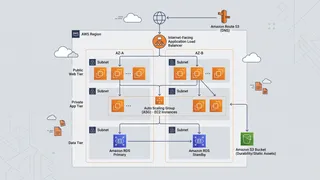 Flashcards
AWS Solutions Architect Associate Flashcards (SAA-C03)
Full exam coverage for the AWS Certified Solutions Architect Associate (SAA-C03) exam. Covers all four domains Resilient, High-Performing, Secure, and Cost-Optimized Architectures.
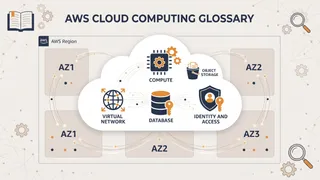 Glossary
Cloud Computing on AWS
Essential Amazon Web Services terms covering compute, storage, networking, databases, and security for cloud engineers and architects.
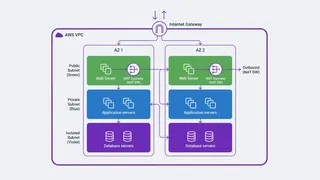 Dev tip
AWS VPC Design Best Practices: Subnets, Route Tables, and Security Groups
How to lay out an AWS VPC so it survives growth: CIDR planning that leaves room, three subnet tiers, one NAT Gateway per AZ, route tables that define what public actually means, security groups referencing each other instead of CIDRs, and the mistakes that cause production outages.
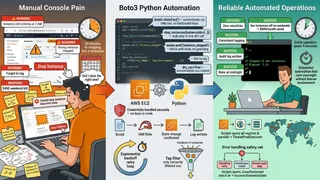 Code snippet
AWS EC2 Instance Management with Boto3: Start, Stop, and Query Instances
Learn how to automate AWS EC2 instance management using Python and Boto3. This guide covers authentication with IAM roles, starting and stopping instances, using waiters, filtering by tags, running bulk operations, and handling API errors. Practical code examples included for DevOps engineers and cloud developers
You might also enjoy
More posts on similar topics
Site Reliability Engineer Beginner to Expert
This roadmap takes you from the fundamentals of Linux and systems thinking through to advanced observability, chaos engineering, and SRE organisational culture. Each stage builds on the last and ties
Release Engineer Beginner to Expert
This roadmap takes you from release engineering principles and version control mastery through to advanced GitOps patterns and multi-account AWS delivery at scale. Each stage builds on the last. Treat
DevOps Engineer Beginner to Expert
This roadmap guides you from Linux fundamentals through to advanced platform engineering and MLOps. Each stage builds on the last, so work through them in sequence to build a well-rounded DevOps skill
JavaScript Beginner to Expert
This roadmap guides you through the complete JavaScript journey from writing your first variable to architecting production-grade applications on the frontend and backend. Work through each stage sequ
Frontend Developer Beginner to Expert
Frontend Developer Beginner to Expert This roadmap walks you from absolute beginner to a strong, hireable frontend engineer. Work through the stages in order. The early ones build the mental model
Backend Developer Beginner to Expert
Backend Developer Beginner to Expert This roadmap walks you from your first server-side program to designing scalable, secure systems. Work through the stages in order. Nail a language, the command
6 related posts