If you’re managing modern cloud-native applications, especially with Kubernetes, you know it can be a real puzzle. Getting containers to work together, handling all those configurations, and scaling things up across different clusters can get overwhelming fast. For a long time, people did these jobs by hand, using custom scripts, or with scattered configuration files. That often led to mistakes, inconsistencies, and a lot of extra work. But as cloud-native tech keeps moving quickly, we really need better, automated, and consistent ways to manage both our infrastructure and our applications.
Think about it: Kubernetes environments are getting more complex, and everyone wants faster delivery, more reliability, and fewer human errors. Doing things manually, what some folks call “ClickOps”, just isn’t going to cut it anymore. Those manual steps become a huge roadblock and a big risk, and they slow down how quickly a company can adapt and compete. This pressure means we need smart, automated solutions, and that’s why methods like Infrastructure as Code (IaC) and GitOps have become so popular.
This post compares two big players for managing modern infrastructure: Infrastructure as Code (IaC) and GitOps. Both want to automate and make operations smoother, but they go about it in pretty different ways. Knowing these differences is super important if you’re looking to get the most out of your Kubernetes setups.
What Infrastructure as Code is, and why it matters for Kubernetes
How does IaC define your infrastructure?
Infrastructure as Code (IaC) is a core DevOps practice where you manage and set up your computing infrastructure using code or configuration files, instead of doing it by hand with graphical tools or scripts. This approach treats infrastructure configurations just like application code, so you can use version control, keep things consistent, and repeat processes reliably. Just like the same code always produces the same software, IaC makes sure your environments are built the same way every single time.
A big strength of IaC, and a key idea for GitOps, is that it’s declarative. Instead of giving step-by-step instructions on how to get to a certain state, which is an imperative way of doing things, common in old-school scripting, IaC simply tells you what the desired end state of your infrastructure should look like. This makes management much simpler, cuts down on human errors, and lets smart tools handle all the complicated steps needed to reach and keep that desired state. This declarative style is what really makes IaC so good for automation, consistency, and reliability, making it a cornerstone for managing modern infrastructure.
What are the core principles of IaC?
IaC is built on a few key ideas that make it effective and dependable:
- Idempotency: Running your IaC code multiple times always gives you the same result. Changes only happen if the code detects a difference between what you want (the desired state) and what’s actually there (the current state). This is super important for predictable and reliable deployments, stopping any accidental side effects from running the same operation over and over.
- Version control: Your infrastructure code lives in a version control system, usually Git. This gives you a complete history of every change, which is great for auditing and lets you quickly go back to earlier configurations if you need to.
- Consistency and standardization: IaC helps make sure that environments, like development, testing, and production, are identical and easy to copy across different stages of your development process. This consistency really cuts down on differences and makes troubleshooting much easier across various environments.
While GitOps explicitly says Git is the “single source of truth,” it is IaC that makes the idea possible in the first place. By focusing on version control and treating code as the definitive way to define infrastructure, IaC creates the ability to have one consistent, auditable source of truth. This shared principle is exactly why GitOps can build so effectively on top of IaC.
What are the benefits of IaC in a Kubernetes environment?
Using IaC in a Kubernetes environment brings a lot of good things:
- Better Tracking and Auditability: You can trace every change made to your infrastructure configuration back to specific commits in your version control system. This gives you a clear and complete history of all modifications. That transparency is incredibly valuable for compliance and figuring out problems.
- Reusability: Since you’re putting your infrastructure setup into code, you can reuse those configurations across different projects and teams. This really cuts down on duplicated effort and helps standardize things across your organization’s infrastructure.
- Consistency: IaC guarantees uniform environments because it uses the same configuration files. This minimizes configuration errors and differences between various development and deployment stages.
- Scalability: IaC lets you quickly copy environments or adjust resources to meet changing demands, without having to manually configure each piece. This ability matters for scaling applications in dynamic cloud environments.
- Fewer Errors: By automating tasks that used to be manual and prone to mistakes, IaC reduces how much humans are involved and the errors that come with it.
- Faster Deployments: IaC helps you deliver applications and their supporting infrastructure quickly and at scale. This supports agile development and gets your products to market faster.
What are the main IaC tools for Kubernetes?
The wide range of IaC tools available, from those that manage cloud provisioning to those that handle Kubernetes-native configurations, shows us that IaC isn’t just one big solution. Instead, it’s a layered way to manage infrastructure. This distinction is important for understanding how different tools work together to manage the entire cloud-native stack effectively.
Some of the popular IaC tools you’ll find in Kubernetes environments include:
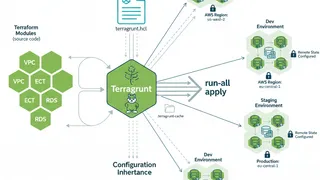
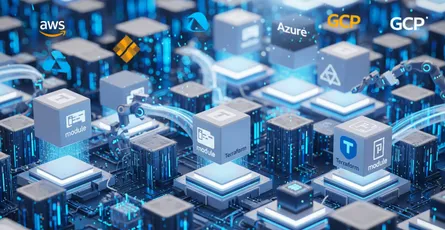
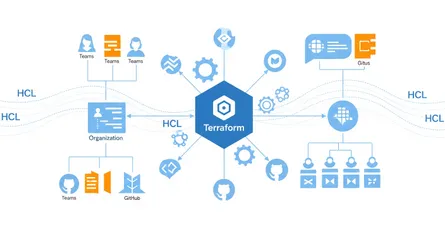
- Terraform: This widely used tool from HashiCorp defines and sets up infrastructure across many cloud providers (like AWS, Azure, GCP) using its declarative HashiCorp Configuration Language (HCL). Terraform is great at provisioning the actual Kubernetes cluster itself (like EKS, AKS, or GKE) and its related cloud infrastructure pieces, such as Virtual Private Clouds, subnets, storage, and Identity and Access Management (IAM) roles.
- Pulumi: An open-source IaC tool that lets you define and manage cloud resources using common programming languages (like Python, TypeScript, Go). This offers flexibility and fits right in with existing codebases, which is appealing to developers who prefer general-purpose languages.
- Ansible: A configuration management and automation tool by Red Hat, known for being simple and not needing agents. It uses YAML playbooks to automate infrastructure setup, configuration, and management tasks.
- Cloud-specific IaC tools: You’ll find examples like AWS CloudFormation, Azure Resource Manager (ARM) templates, and Google Cloud Deployment Manager. These tools are really popular in their specific cloud environments for defining and managing resources.
- Helm: A package manager for Kubernetes that uses “charts” to define, install, and upgrade even complex Kubernetes applications. Its templating system gives you a solid way to manage environment-specific values, allowing for consistent deployments with different configurations.
- Kustomize: A Kubernetes-native tool that lets you customize raw YAML files. It allows for environment-specific overlays without needing templating, giving you a flexible way to manage configurations for different deployment targets.
- Crossplane: This tool extends Kubernetes to manage external infrastructure resources, letting you provision and manage cloud services directly through Kubernetes APIs. It brings the Kubernetes control plane experience to managing outside cloud services.
Terraform usually works at the infrastructure layer, setting up the underlying cloud resources and the Kubernetes cluster itself. On the other hand, tools like Helm and Kustomize manage the application and configuration layer inside Kubernetes. This clear division of responsibilities among IaC tools, based on how “deep” they go into the infrastructure, means that managing cloud-native infrastructure effectively often requires using several tools. You’ll combine different IaC tools to manage distinct layers of your infrastructure, from the cloud resources underneath to the containerized applications running on Kubernetes.
GitOps, a Git-centric approach to Kubernetes management
What makes GitOps different from traditional IaC?
GitOps is a modern way of operating that applies DevOps ideas, especially continuous delivery, to infrastructure automation. It basically uses Git repositories as the single source of truth for defining and managing all your infrastructure and application configurations. This approach completely changes how infrastructure is managed by giving you a clear, consistent, and automated way to deploy, monitor, and manage applications, making sure your system’s desired state is always versioned and unchangeable.
GitOps takes the idea of Infrastructure as Code a step further by adding a strict Git-focused workflow and a continuous reconciliation process, especially tuned for Kubernetes. This means GitOps uses IaC to define what the desired state should be, but then it enforces a specific workflow (Git-focused, pull-based, continuous reconciliation) to manage and keep that state in a live system.
What GitOps is, and its core principles
The OpenGitOps standards group defines GitOps through four main principles:
- Declarative: The desired state of the system (how it should be set up) is clearly stated in Git. This means the configuration tells you the outcome you want, and the system automatically works to match and maintain this defined state.
- Versioned and Immutable: The desired state is stored in Git in a way that makes it unchangeable and versioned, keeping a full history of all modifications. This gives you an accurate audit log for every change, allowing for complete traceability and reproducibility.
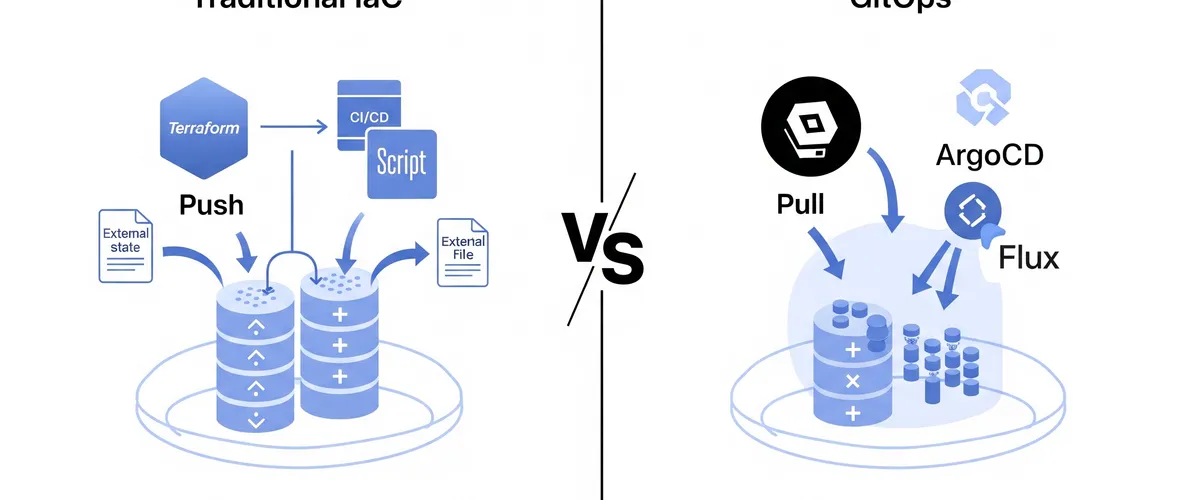
- Pulled Automatically: Software agents, often Kubernetes Controllers, automatically pull the desired state declarations from the Git repository. This “pull-based” model is a key difference from traditional “push-based” CI/CD pipelines, where external tools push changes to the cluster.
- Continuously Reconciled: These software agents constantly watch the actual system state within the Kubernetes cluster, compare it to the desired state defined in Git, and automatically apply changes to fix any differences they find. This continuous loop makes sure the system stays in the desired state, actively finding and fixing “configuration drift”.
The pull-based deployment model that’s central to GitOps offers a big security advantage over traditional push-based CI/CD workflows. In a traditional setup, CI/CD pipelines often need direct write access to production clusters, which can be a weak point for attacks. With GitOps, the agent living inside the Kubernetes cluster pulls changes from Git. This design means fewer outside CI/CD systems need to hold broad credentials to the production environment, which cuts down on potential attack areas and centralizes access control and auditing around the Git repository itself. This shift in architecture from push to pull really improves overall security by reducing direct external access to the live environment, making Git the main gatekeeper for changes.
How GitOps extends IaC for Kubernetes
GitOps applies and builds on IaC principles by using Git as the central backbone for all infrastructure management, making sure everything is consistent and reliable. It gives you a structured and automated way to define what your system should look like, specifically Kubernetes manifests and configurations, in Git. Then, it constantly checks and adjusts the actual state of the cluster to match this defined state.
While Infrastructure as Code (IaC) mainly focuses on defining infrastructure as code, GitOps takes this idea and turns it into a full operational model. What matters is how that code is managed, deployed, and continuously kept up to date in a live system, not simply that the code exists. GitOps effectively turns Git into a dynamic control center for operations, providing the constant feedback loop and automated reconciliation needed for very active Kubernetes environments. IaC gives you the declarative definition (the “what”), while GitOps gives you the automated process for deploying, monitoring, and maintaining that definition in a live system (the “how”). This moves beyond static configuration files to a dynamic operational workflow. GitOps puts IaC into action, providing the continuous feedback loop and automation needed to manage the lifecycle of applications and infrastructure in dynamic Kubernetes environments, making Git the central point of control for operations.
What are the main GitOps tools?
While both ArgoCD and Flux do a great job of implementing GitOps, their core design philosophies are quite different. This fundamental distinction affects how organizations choose, customize, and fit these tools into their broader cloud-native ecosystem, influencing how users experience them and how flexible the architecture can be.
- ArgoCD: This tool is described as a “declarative, GitOps continuous delivery tool for Kubernetes.” ArgoCD constantly watches Git repositories for changes and automatically deploys those changes to the cluster. It compares the state you’ve declared in Git with what’s actually running in the cluster and applies any necessary changes to fix discrepancies.
- Key Features: Automated synchronization, managing multiple clusters from one interface, better security features like Role-Based Access Control (RBAC) and Single Sign-On (SSO) integration, full audit trails, a Kubernetes-native architecture, detailed visualization and monitoring through a web UI, and built-in rollback capabilities.
- Strengths: ArgoCD offers a full-featured, easy-to-use web UI, application-focused management, advanced features like ApplicationSets for managing many applications at once, and its own custom RBAC system. Organizations often prefer it if they’re looking for a more “platform-like” and opinionated experience, giving them a complete view of application states and deployments.
- Use Cases: Making Kubernetes deployments smoother, improving teamwork between development and operations teams, and providing a solid base for continuous delivery in cloud-native environments.
- Flux CD: An open-source continuous delivery tool designed to implement GitOps processes for Kubernetes clusters. It runs as a set of controllers right inside your Kubernetes cluster, constantly watching connected Git repositories for changes and synchronizing the cluster’s state to match the configuration defined in Git.
- Key Features: Automated software rollouts, strong rollback capabilities, support for multiple environments, native Kubernetes RBAC support, a multi-tenant enabled architecture, and compatibility with the Kubernetes Cluster API for managing other clusters. It easily integrates with a wide range of ecosystem tools including Helm, Kustomize, Grafana, Prometheus, Kyverno, and SOPS. Flux also includes image reflector and automation controllers for automatically updating container images, and notification controllers for alerts.
- Strengths: Flux focuses on simplicity and smooth integration with Kubernetes APIs, following an extensible “toolkit” approach. It relies on Kubernetes-native RBAC and has strong community support. It’s a good fit for building custom tools on top and is becoming a popular choice for external vendors integrating GitOps.
- Ultimately, choosing between ArgoCD and Flux depends on whether an organization prefers a ready-made, opinionated solution or a highly customizable, Kubernetes-native approach, and how comfortable they are with dedicated GitOps applications versus a collection of integrated Kubernetes controllers.
GitOps vs. traditional IaC, side by side for Kubernetes deployments
How do their deployment workflows differ (push vs. pull)?
The main difference between GitOps and traditional IaC comes down to how they deploy things:
- Traditional IaC (Push-based): In this workflow, developers commit new code changes to version control. A Continuous Integration (CI) server then runs automated tests. If everything looks good, it pushes the newly built container image to a repository. After that, an automated deployment tool pushes these containers to the production environment. The CI part is usually at the heart of this whole process.
- GitOps (Pull-based): The initial CI process (code commit, testing, image building) pretty much stays the same. However, the deployment phase is quite different. When a new container image or configuration change is ready, a GitOps agent, often a Kubernetes Controller like ArgoCD or Flux, pulls the desired state from the Git repository and applies it to the cluster. In this model, Git itself is central, acting as the single source of truth that the agent constantly monitors and synchronizes with.
The pull-based model of GitOps naturally offers a big security benefit over traditional push-based IaC. In traditional setups, CI/CD pipelines often need direct, broad write access to target production clusters, which can be a significant security risk or attack point. With GitOps, the agent running inside the cluster pulls changes from Git. This design means fewer external systems, like CI servers, need direct, high-privilege credentials to the live production environment. This reduces the overall attack surface and centralizes access control and auditing mainly around the Git repository. This fundamental architectural difference leads to a stronger security posture for GitOps by design, effectively making Git the primary gatekeeper and audit log for all changes, rather than relying on potentially more vulnerable external pipelines.
How do they manage infrastructure state and detect configuration drift?
Managing infrastructure state and finding configuration drift are critical areas where GitOps and traditional IaC approaches go in different directions:
- Traditional IaC: Defines the desired state of infrastructure through code. Tools like Terraform keep a “state file” that tracks the current actual state of the infrastructure, which they then compare against the desired state for consistency. However, configuration drift, when the actual state deviates from the desired state, can still happen because of manual changes made directly to the infrastructure or inconsistencies missed during deployment. Finding drift in traditional IaC often means running a command, like terraform plan, to compare the live state against the IaC files. This can be a manual or scheduled process.
- Challenges: If someone makes manual changes directly to the environment, those changes can accidentally get reverted during the next automated IaC deployment. This could lead to instability, unexpected behavior, or even reintroducing security vulnerabilities. Detecting and managing drift at a large scale can be tough without constant, automated monitoring.
- GitOps: Git is clearly set as the single source of truth for the desired state of the entire system. GitOps agents (Kubernetes Controllers) constantly monitor the actual state of the Kubernetes cluster and compare it with the desired state defined in the Git repository. If they find any difference (drift), the agent automatically fixes it by applying the desired state from Git, essentially “self-healing” the cluster.
- Benefits: This approach offers active detection and automated fixing of configuration drift, making sure the system is continuously consistent and reliable. This constant enforcement also subtly encourages teams to commit any manual changes back to version control, because they know those changes will otherwise be reverted.
Traditional IaC often relies on reactive drift detection. This means you perform a manual or scheduled check, like running a terraform plan, to find differences between the desired and actual states. GitOps, however, is all about proactive, continuous reconciliation. This means the system doesn’t just tell you about drift; it actively and automatically fixes it by constantly enforcing the desired state from Git. This continuous feedback loop is a big operational advantage, turning drift management from a reactive troubleshooting burden into a built-in, self-correcting mechanism. This leads to higher stability and reliability with less human involvement. This continuous, automated reconciliation in GitOps fundamentally changes how we handle drift management, moving it from a reactive, human-driven task to a proactive, system-driven, self-healing process. This significantly improves the reliability and consistency of Kubernetes environments.
End to end, a GitOps change is just a merge that the agent picks up and applies:
What are the security implications and best practices for each?
Security is super important in any infrastructure management strategy, and both IaC and GitOps have their own distinct things to consider:
- Traditional IaC Security:
- Vulnerabilities: Common security flaws include mistakes in IaC files (like insecure default settings or open ports), vulnerabilities in container images, and the risky practice of putting sensitive secrets (passwords, API keys) directly into code.
- Best Practices: Use IaC scanners to find misconfigurations early in development. Use container scanning tools to detect known vulnerabilities in container images. Employ secrets scanning tools to stop sensitive data from being hard-coded. Put these security checks right into your CI/CD pipelines to automatically enforce security policies. Plus, use policy-as-code tools like Open Policy Agent (OPA) or Kyverno to make sure configurations follow your organization’s security policies before deployment. Most importantly, prevent direct access to the Kubernetes API server from unauthorized sources, make sure all cluster communications use TLS, and encrypt sensitive data stored in etcd.
- GitOps Security:
- Benefits: GitOps naturally provides stronger security. Git’s cryptographic features for tracking changes and proving who made them improve the integrity of your desired state. The unchangeable and auditable nature of Git history is invaluable for responding to incidents and rebuilding systems after a breach. The pull-based model reduces potential attack areas by limiting the need for CI/CD tools to have direct, broad access to the cluster. It also actively finds and fixes unauthorized changes made directly to the cluster.
- Challenges: A big challenge is securely managing secrets. Storing sensitive information directly in plain text in Git repositories is a major security risk. Also, making sure you have fine-grained access control to sensitive Git repositories themselves matters, because unauthorized write access could introduce harmful changes.
- Best Practices: To handle secrets, encrypt them before storing them in Git using tools like Bitnami Sealed Secrets or Mozilla SOPS. Another option is to store references to secrets in external, specialized secret backends (like HashiCorp Vault, AWS Secrets Manager) and use tools like External Secrets Operator to pull and inject them into the cluster during deployment. Enforce strong Role-Based Access Control (RBAC) at the Git repository level to control who can suggest and merge changes. Other general security practices include network segmentation, following the principle of least privilege, keeping all software components up to date, and continuously monitoring and auditing your system.
Both IaC and GitOps fundamentally promote “shift-left” security, meaning you can do security checks earlier in the development process by defining infrastructure and configurations in code. However, GitOps really steps this up by making Git the central control point for all operational changes. This centralized, Git-driven workflow makes security auditing, compliance enforcement, and fixing vulnerabilities more consistent, transparent, and naturally integrated throughout the entire operational lifecycle. This strengthens your overall security posture by design. While IaC allows for early security checks on the code itself, GitOps enforces a process where every change, including security updates or fixes, must start and be reviewed in Git. This creates a more thorough and auditable security posture across the entire change management process.
How do they handle rollbacks and keep systems reliable?
Being able to quickly and reliably undo changes is super important for system reliability:
- Traditional IaC: Rollbacks are generally possible by going back to an earlier version of your IaC codebase. This involves finding the last known stable configuration files and reapplying them to your infrastructure. This process can sometimes be manual or partly automated, depending on your tools and pipeline setup.
- GitOps: Offers a built-in and much simpler way to roll back. Because the desired state of your entire system is stored and versioned in Git, going back to a previous version is as easy as reverting a commit in your Git repository. The GitOps agent then automatically spots this change in Git and brings the cluster back to that previous desired state. This gives you a clear record of changes and really simplifies disaster recovery, since you can recreate your entire system from Git.
- Challenges with Stateful Applications: While GitOps rollbacks work really well for stateless resources (like container deployments or network configurations), they get tricky with stateful applications, especially databases. Reverting a database schema change (like dropping a column) can lead to permanent data loss, because the reverse operation doesn’t bring back the original data. This shows a critical limitation where GitOps principles alone aren’t enough. You need to handle these situations carefully, often using specialized database operators or migration tools that understand schema intent and data integrity.
GitOps gives you a more predictable and naturally reliable way to roll back because the entire system’s desired state is stored and managed in Git. This is a sharp contrast to traditional methods, where rollbacks might involve more manual steps or a less clear understanding of the exact state you’re reverting to. However, this predictable nature hits a big limit when you’re dealing with stateful data, like databases. While GitOps can revert the code that defines a database schema, it can’t magically bring back lost data. This means organizations have to look at specialized solutions, including database operators or careful migration strategies, to truly achieve “rollbackability” for stateful components. This highlights a nuanced challenge in the otherwise smooth promise of GitOps. While GitOps significantly simplifies rollbacks for most Kubernetes resources, it requires a deeper, more specialized approach to managing stateful data, often needing extra tools or patterns beyond the core GitOps framework.
How do they affect team collaboration and auditability?
Both IaC and GitOps really change how teams work together and how easy it is to audit things, though they focus on different aspects:
- Traditional IaC: By putting infrastructure into code, IaC naturally encourages teamwork, because changes are visible in version control and can be reviewed openly. Using version control systems also greatly improves auditability by providing a history of who changed what and when.
- GitOps: Significantly improves collaboration by centralizing all code reviews and important discussions directly within Git pull requests. The Git repository becomes the single, complete place for all infrastructure and application changes. This really helps with bringing new team members on board and makes things more transparent across development and operations teams. This approach gives you a clear, unchangeable record of who made which changes, when, and why, which matters for compliance and troubleshooting.
GitOps uses Git not just as a version control system for code, but as the main, centralized hub for all operational changes. This systematic use of Git’s collaborative features, like pull requests, code reviews, and commit history, naturally leads to better communication and alignment between development and operations teams (“DevOps”) by standardizing the change process around familiar Git workflows. It creates a shared language and process for everyone involved in managing the system. By funneling all changes and discussions through Git’s established collaborative mechanisms, GitOps naturally bridges the traditional communication gaps between development and operations teams. Everyone works from the same “source of truth” using familiar tools. GitOps transforms Git into the central “meeting point” for all infrastructure and application changes, leading to better transparency, accountability, and smoother cross-functional collaboration, which are core tenets of the DevOps philosophy.
Here’s a quick look at the key differences:
Table 1: GitOps vs. Traditional IaC: Key Differences
| Feature | Traditional IaC | GitOps |
|---|---|---|
| Source of Truth | CI/CD pipeline logic / IaC files | Git repository |
| Deployment Model | Push-based (CI pushes to cluster) | Pull-based (agent pulls from Git) |
| State Management | External state files / manual tracking | Git as desired state / continuous reconciliation |
| Drift Detection | Reactive (manual/scheduled checks via plan) | Proactive (automated agent reconciliation) |
| Rollback Mechanism | Revert IaC files (manual/semi-automated) | Revert Git commit (automated by agent) |
| Primary Focus | Infrastructure definition and provisioning | Application/Infrastructure operations |
| Tooling Examples | Terraform, Pulumi, Ansible | ArgoCD, Flux |
| Security Implication | Direct cluster access for CI/CD | Reduced direct cluster access for CI |
| Operational Model | Imperative (scripts define steps) or Declarative (tools apply desired state) | Declarative (system reconciles to Git) |
Integrating Terraform with GitOps
Can Terraform be “GitOpsed” for Kubernetes infrastructure?
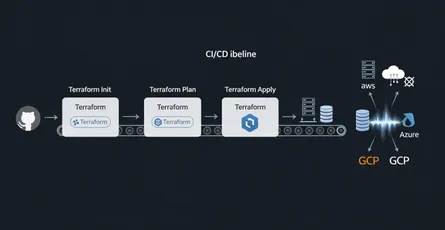
Yes, Terraform’s declarative nature fits really well with GitOps principles. This means you can put Terraform code under version control in Git, and changes can be automatically applied to your infrastructure based on Git merges. Terraform is excellent at setting up the underlying cloud infrastructure that Kubernetes clusters run on, including virtual machines, networking pieces, databases, and even the Kubernetes cluster itself as a managed service (like EKS, AKS, or GKE). GitOps tools like ArgoCD and Flux then typically manage the applications and configurations deployed within that Kubernetes cluster.
Patterns for combining Terraform’s provisioning with GitOps’ operational model
The different ways you can integrate these tools clearly show that Terraform and GitOps aren’t competing; they actually have strengths that complement each other. Terraform is great at setting up the foundational, broader infrastructure, like the Kubernetes cluster itself and its cloud resources. GitOps, on the other hand, excels at managing the dynamic state of applications and configurations deployed on that foundation. The main challenge is cleanly connecting these two layers while strictly keeping Git as the single source of truth across the entire stack. The most effective strategy often involves using both tools where they’re strongest.
Here are common ways to combine them:
- “GitOpsing Terraform”: This approach involves setting up a dedicated Git repository to store your Terraform code. You define your infrastructure configurations in this code, and then you set up a CI/CD pipeline to use Terraform to apply changes to the infrastructure. These applications are triggered by Git merges or pull requests.
- The GitOps Bridge Pattern (with caveats): A common, though sometimes tricky, approach involves Terraform setting up the infrastructure and then exporting certain values (like Kubernetes cluster endpoints, IDs, or other metadata) that ArgoCD applications need. These values are often put into Kubernetes cluster secrets or annotations, which ArgoCD then uses.
- Drawbacks: This pattern often requires using ArgoCD’s ApplicationSets feature, which might not be ideal for simpler setups. Importantly, it can break Git as the single source of truth, because metadata used by ArgoCD comes from cluster secrets rather than directly from Git. It can also lead to bloated inline Helm values and generally doesn’t work with Kustomize.
- Improved GitOps-friendly integration: A more reliable and truly GitOps-aligned approach involves using Terraform to directly write Kubernetes-native configuration files, such as Helm values or Kustomize overlays, into Git. You can do this using Terraform providers, like the GitHub provider, that support creating and updating files or even opening pull requests directly in a Git repository.
- Benefits: This method makes sure Git remains the clear single source of truth for all desired states, including application configurations. All changes go through standard Git pull request workflows, and it works perfectly with both Helm and Kustomize, so you don’t need complex plugins or secret injection tricks. This pattern ensures that the desired state for your Kubernetes applications, like specific Helm values or Kustomize configurations, is also versioned and managed in Git, fully aligning with GitOps principles.
For many organizations, the best approach isn’t to pick one over the other, but to combine them strategically. Terraform sets up the stable, underlying infrastructure, and GitOps makes sure applications are continuously and automatically deployed and reconciled on top of it, always being careful to keep Git as the clear single source of truth across the entire stack.
Frequently Asked Questions
Is GitOps a replacement for DevOps?
No, GitOps isn’t a replacement for DevOps; instead, it’s a modern, specialized approach within the broader DevOps philosophy. DevOps covers a culture and a set of practices aimed at making the software development life cycle shorter and providing continuous delivery with high-quality software. GitOps is a specific set of practices and tools, especially well-suited for Kubernetes environments, that helps achieve DevOps goals by using Git as the single source of truth. It makes deployment and operations smoother, allowing for more automation, better traceability, and faster rollbacks, all of which are central to DevOps principles. GitOps essentially applies DevOps principles like version control, collaboration, and automation directly to configuration management and infrastructure operations.
Can GitOps be applied beyond Kubernetes?
Yes, while many popular GitOps tools, like ArgoCD and Flux, are heavily designed for and integrated with Kubernetes, the core ideas of GitOps can be applied to manage any type of infrastructure. This means you’d need the right plugins, operators, or custom tools to enable Git-driven reconciliation for non-Kubernetes resources. Challenges when using GitOps outside of Kubernetes can include making sure different resource types are idempotent, managing the creation and deletion of non-Kubernetes assets, and handling secrets securely in various environments.
What are the common challenges when adopting GitOps?
While GitOps offers big benefits, getting started with it can come with several challenges:
- Initial Setup Complexity: Setting up a GitOps workflow can be complicated at first. It requires careful planning for Git repositories, branching strategies, and proper Role-Based Access Control (RBAC).
- Managing Secrets: A critical security concern is how to handle sensitive information (secrets) without storing them in plain text in Git. This means you’ll need specialized tools like Bitnami Sealed Secrets or External Secrets Operator.
- Handling Large Scale Deployments: As your infrastructure grows, managing configurations for many environments, applications, or across many Kubernetes clusters can get complex. Scaling GitOps tools like ArgoCD or Flux across hundreds of clusters might mean deploying multiple instances or using specialized platforms built for enterprise scale.
- Ensuring Consistency Across Environments: While GitOps aims for consistency, keeping it consistent across diverse and numerous environments can still be a challenge.
- Monitoring and Observability: Strong monitoring and observability tools are needed to constantly compare the desired state with the actual state and effectively spot differences.
- Merge Conflicts: With all changes going through Git, handling merge conflicts, especially in large teams with frequent changes, requires careful planning and good Git practices.
- State Drift (Temporary): Even though GitOps tools continuously reconcile, temporary state drift can still happen if systems fail to apply changes correctly or if there are outside, unmanaged interventions.
Even though GitOps really focuses on automation, successfully putting it into practice brings new, significant human-centered challenges. These include needing strict Git hygiene, building a highly collaborative environment, and disciplined secret management. The real success of GitOps depends not just on what the tools can do, but deeply on organizational discipline and a cultural shift towards treating Git as the central control center for all operations.
Conclusion
The journey from managing infrastructure by hand to using automated, codified approaches has been a huge change. Infrastructure as Code (IaC) laid the groundwork, and GitOps built on that to create a super efficient and secure way to operate Kubernetes.
Traditional IaC, with its focus on defining infrastructure through code and using version control, gives you basic benefits like consistency, reusability, and fewer errors. It changed the game from giving step-by-step instructions to simply declaring what you want, making complex infrastructure setup much easier. Tools like Terraform are great at managing the underlying cloud resources and Kubernetes clusters themselves, creating a stable foundation.
GitOps, as an evolution of IaC, takes these ideas further by making Git the single source of truth for all your infrastructure and application configurations. Its pull-based deployment model, continuous reconciliation by agents inside the cluster, and built-in auditability offer big advantages in security, automated drift detection, and simpler rollbacks. GitOps turns Git into a dynamic control center, putting IaC into action to make sure what you want always matches what’s actually running. Tools like ArgoCD and Flux provide strong ways to implement this method, each with different ideas about user experience and how much you can extend them.
Comparing the two shows that GitOps offers a more proactive, self-healing, and secure way to deploy to Kubernetes, especially because of its pull-based architecture and continuous reconciliation loop. While traditional IaC might rely on reactive drift detection, GitOps actively enforces the desired state, keeping configuration drift to a minimum. Plus, GitOps makes Git more than just a version control system; it turns it into a central place for all operational changes, leading to better communication and alignment across development and operations teams.
For organizations managing Kubernetes, the choice isn’t necessarily between IaC and GitOps, but rather how to best combine their strengths. Terraform can set up the foundational Kubernetes infrastructure, while GitOps tools like ArgoCD or Flux can manage the applications and configurations deployed within those clusters. The most effective strategies involve using both where they’re best, always being careful to keep Git as the clear single source of truth across the entire stack.
While GitOps promises a lot of automation and reliability, successfully adopting it means tackling challenges like the initial setup complexity, securely managing secrets, and keeping up good Git practices. Ultimately, the real value of GitOps isn’t just in what it can do technically, but in its ability to build a disciplined, collaborative culture that treats Git as the definitive source for all operational changes, driving consistency, security, and agility in the cloud-native world.
References
- What is Infrastructure as Code? - IaC Explained - AWS, accessed on June 6, 2025, https://aws.amazon.com/what-is/iac/
- Deploy your first app on Kubernetes with GitOps | CNCF, accessed on June 6, 2025, https://www.cncf.io/blog/2024/09/09/deploy-your-first-app-on-kubernetes-with-gitops/
- What Is GitOps? The Complete Guide - Komodor, accessed on June 6, 2025, https://komodor.com/blog/what-is-gitops-the-complete-guide/
- GitOps Workflow vs. Traditional Workflow: What Is the Difference? - Codefresh, accessed on June 6, 2025, https://codefresh.io/learn/gitops/gitops-workflow-vs-traditional-workflow-what-is-the-difference/
- What is Argo CD? Overview & Tutorial - Spacelift, accessed on June 6, 2025, https://spacelift.io/blog/argocd
- What is Flux CD & How Does It Work? [Tutorial] - Spacelift, accessed on June 6, 2025, https://spacelift.io/blog/fluxcd
- Flux CD vs. Argo CD: GitOps Tools Comparison - Spacelift, accessed on June 6, 2025, https://spacelift.io/blog/flux-vs-argo-cd
- IaC in Kubernetes: 6 Tools, Tutorial and Tips for Success - Codefresh, accessed on June 6, 2025, https://codefresh.io/learn/infrastructure-as-code/iac-kubernetes/
- Drift Detection in Kubernetes - Komodor, accessed on June 6, 2025, https://komodor.com/blog/drift-detection-in-kubernetes/
- How to apply security at the source using GitOps - Sysdig, accessed on June 6, 2025, https://sysdig.com/blog/gitops-iac-security-source/
- The Hard Truth about GitOps and Database Rollbacks - Atlas, accessed on June 6, 2025, https://atlasgo.io/blog/2024/11/14/the-hard-truth-about-gitops-and-db-rollbacks
- How to Integrate Terraform with Argo CD for GitOps Workflows - Akuity, accessed on June 6, 2025, https://akuity.io/blog/yet-another-take-on-integrating-terraform-with-argo-cd
- GitOps Your Terraform in 4 Easy Steps | Codefresh, accessed on June 6, 2025, https://codefresh.io/learn/gitops/gitops-your-terraform-in-4-easy-steps/
- Kubernetes Security Best Practices: Definitive Guide | CSA, accessed on June 6, 2025, https://cloudsecurityalliance.org/blog/2022/03/03/kubernetes-security-best-practices-definitive-guide
- Infrastructure as code vs. GitOps, a real-world example - fredrkl, accessed on June 6, 2025, https://fredrkl.com/blog/infrastructure-as-code-vs-gitops-a-real-world-example/