Introduction
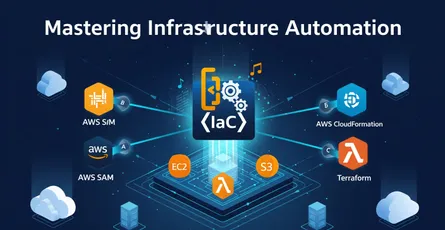
AWS CloudFormation is one of the core Infrastructure as Code (IaC) tools on AWS. It lets you declare your infrastructure using JSON or YAML templates, which simplifies creation and management. Instead of tangled manual configurations and one-off resource provisioning, you get consistent, repeatable infrastructure builds.
What CloudFormation does
AWS CloudFormation is a service that lets you define and provision your infrastructure resources declaratively. You codify your infrastructure requirements in JSON or YAML templates that capture the desired state of your resources, and CloudFormation creates them consistently and reliably.
Declaring infrastructure with templates
JSON or YAML
CloudFormation supports both JSON and YAML for template definitions. Pick whichever format suits the way you and your team work.
Resource definitions
With CloudFormation templates, you define your infrastructure resources, such as Amazon EC2 instances, Amazon RDS databases, and Amazon S3 buckets. You specify properties, dependencies, and configurations for each resource, and the result is a blueprint for your infrastructure.
Stack management
CloudFormation organizes your resources into stacks so you can manage and provision them as a single unit. Stacks let you create, update, and delete your infrastructure in a controlled, orchestrated way.
Managing updates and rollbacks
Change sets
CloudFormation introduces the concept of change sets, which allow you to preview the impact of proposed changes before applying them. Change sets give you a safety net. You can review modifications and weigh the risks before the changes reach your infrastructure.
Rollback and recovery
If an update fails, CloudFormation’s rollback mechanism reverts the stack to its previous state, so your infrastructure stays consistent even when something goes wrong.
The advantages of CloudFormation in IaC
Automation and consistency
CloudFormation enables automation and repeatability in your infrastructure provisioning process. By defining your infrastructure as code, you eliminate manual configurations, which cuts human error and keeps deployments consistent.
Version control and collaboration
CloudFormation templates can be stored in version control systems, giving you a history of changes and letting team members collaborate. Multiple contributors can work together, track modifications, and roll back changes if necessary, which keeps the workflow auditable.
Modular and scalable
CloudFormation templates allow for modularity and scalability in infrastructure design. You can create reusable components, called nested stacks, that can be shared across multiple templates, which keeps things consistent and saves you from repeating the same definitions.
Best practices for CloudFormation in IaC
Parameterization
Parameterizing your CloudFormation templates gives you room to customize them. By externalizing values, you can easily adjust configurations for different environments or use cases without modifying the template itself.
Testing and validation
Testing your CloudFormation templates helps confirm they’re correct and reliable. Tools like AWS CloudFormation Linter and AWS CloudFormation Guard can help validate the syntax, structure, and security of your templates.
Infrastructure as code pipeline
Integrating CloudFormation with continuous integration/continuous deployment (CI/CD) pipelines allows for automated and controlled deployments. You can use AWS CodePipeline and AWS CodeBuild to automatically test, validate, and deploy your infrastructure changes.
Conclusion
AWS CloudFormation gives you a consistent, repeatable way to manage infrastructure automation. With CloudFormation templates, you can declare your infrastructure resources, manage updates, and keep your infrastructure organized as it grows.
References
- AWS CloudFormation User Guide, https://docs.aws.amazon.com/AWSCloudFormation/latest/UserGuide/Welcome.html
- What is Infrastructure as Code? - AWS, https://aws.amazon.com/what-is/iac/
- AWS CloudFormation Template Reference, https://docs.aws.amazon.com/AWSCloudFormation/latest/UserGuide/template-reference.html
- Working with Stacks - AWS CloudFormation, https://docs.aws.amazon.com/AWSCloudFormation/latest/UserGuide/stacks.html
- Updating Stacks Using Change Sets - AWS CloudFormation, https://docs.aws.amazon.com/AWSCloudFormation/latest/UserGuide/using-cfn-updating-stacks-changesets.html
- AWS CloudFormation Best Practices, https://docs.aws.amazon.com/AWSCloudFormation/latest/UserGuide/best-practices.html
- Using Parameters - AWS CloudFormation, https://docs.aws.amazon.com/AWSCloudFormation/latest/UserGuide/parameters-section-structure.html
- AWS CloudFormation Linter (cfn-lint.), https://github.com/aws-cloudformation/cfn-lint
- AWS CloudFormation Guard, https://github.com/aws-cloudformation/cloudformation-guard
- AWS CodePipeline User Guide, https://docs.aws.amazon.com/codepipeline/latest/userguide/welcome.html
- AWS CodeBuild User Guide, https://docs.aws.amazon.com/codebuild/latest/userguide/welcome.html
- Nested Stacks - AWS CloudFormation, https://docs.aws.amazon.com/AWSCloudFormation/latest/UserGuide/using-cfn-nested-stacks.html
- AWS CloudFormation Workshops, https://workshops.aws/categories/Management%20Tools#CloudFormation