Introduction
Terraform is a tool for infrastructure orchestration that lets you create and manage infrastructure across multiple cloud providers. With Terraform, you provision resources on AWS by writing infrastructure configurations in a declarative language. This post covers how Terraform provisions infrastructure and the practices that make it reliable to use.
How Terraform works
Infrastructure as Code
Terraform is built on Infrastructure as Code (IaC), so you define and manage your infrastructure using code. Codifying your infrastructure configurations gives you reproducibility, scalability, and version control.
Declarative language
Terraform uses a declarative language called HashiCorp Configuration Language (HCL). This language lets you express your desired infrastructure state without specifying the detailed steps for achieving it; Terraform figures out the steps and orchestrates the provisioning process.
Terraform in action
Resource providers
Terraform supports various resource providers, including AWS, Azure, Google Cloud, and many more. With the AWS provider, you can provision AWS resources such as EC2 instances, S3 buckets, and VPCs.
Infrastructure configuration
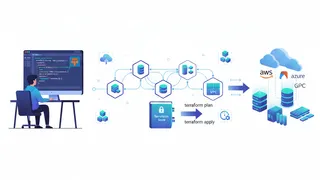
Terraform uses configuration files called “Terraform files” to define your infrastructure. In these files, you specify the resources you want to create, their properties, and any dependencies between them. Terraform reads these files to work out the order of resource creation, then provisions everything in that order.
Execution plans
Before applying changes, Terraform generates an execution plan that outlines the actions it will take to achieve the desired infrastructure state. This plan lets you preview the changes, so you stay in control of the provisioning process.
Provisioning infrastructure
Init and apply
Terraform requires an initialization step to download the necessary provider plugins and set up the execution environment. Once initialized, you provision the defined infrastructure resources by running terraform apply.
State management
Terraform maintains a state file that keeps track of the current state of your infrastructure. This file lets Terraform see the differences between the desired state and the actual state, so it can make the changes needed to close the gap.
Efficiency and collaboration
Infrastructure modules
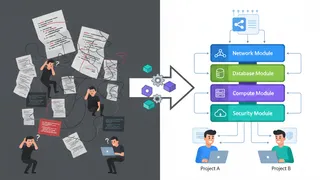
Terraform allows you to create reusable modules, which are self-contained configurations that encapsulate a set of resources and their dependencies. These modules let you reuse code and keep your infrastructure consistent.
Version control and collaboration
By treating Terraform configurations as code, you can store them in version control systems, which lets team members work together and gives you a history of changes. You also get proper code management and easy rollbacks.
Extending with providers and modules
Terraform is extensible. You can pull in extra providers and modules to widen what it does. This flexibility lets you integrate with different cloud providers and use community-created modules for common infrastructure patterns.
Best practices for Terraform
Infrastructure as Code principles
Apply best practices of Infrastructure as Code, such as using version control, documenting changes, and reviewing code, to keep your Terraform configurations reliable and maintainable.
Terraform workspaces
Use Terraform workspaces to manage different environments and keep separate state files. Workspaces let you deploy and manage development, testing, and production infrastructure independently.
Terraform Cloud and CI/CD integration
Consider using Terraform Cloud or integrating Terraform into your CI/CD pipelines to automate the provisioning process, enforce policies, and enable collaboration within your infrastructure provisioning workflows.
Conclusion
Terraform lets you create and manage infrastructure across multiple cloud providers with a consistent, repeatable workflow. By applying Infrastructure as Code principles and using Terraform’s declarative model, you can orchestrate your infrastructure reliably and with less manual effort.
References
- Terraform by HashiCorp - Official Website, https://www.terraform.io/
- Terraform Documentation, https://developer.hashicorp.com/terraform/docs
- Terraform AWS Provider Documentation, https://registry.terraform.io/providers/hashicorp/aws/latest/docs
- Infrastructure as Code - AWS, https://aws.amazon.com/what-is/iac/
- HashiCorp Configuration Language (HCL.), https://github.com/hashicorp/hcl
- Terraform Modules - Terraform Documentation, https://developer.hashicorp.com/terraform/language/modules
- Terraform State Management - Terraform Documentation, https://developer.hashicorp.com/terraform/language/state
- Terraform Workspaces - Terraform Documentation, https://developer.hashicorp.com/terraform/language/state/workspaces
- Terraform Cloud, https://www.hashicorp.com/products/terraform
- Best Practices for using Terraform - Gruntwork, https://www.gruntwork.io/blog/a-comprehensive-guide-to-terraform
- Getting Started with Terraform on AWS - AWS Workshop, https://catalog.workshops.aws/terraform-beginner-to-pro/en-US
- Terraform Registry (for providers and modules.), https://registry.terraform.io/