Introduction
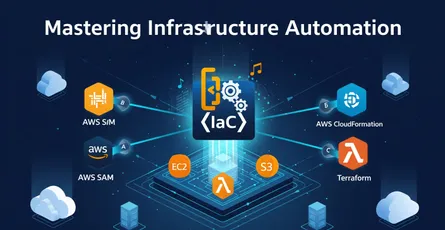
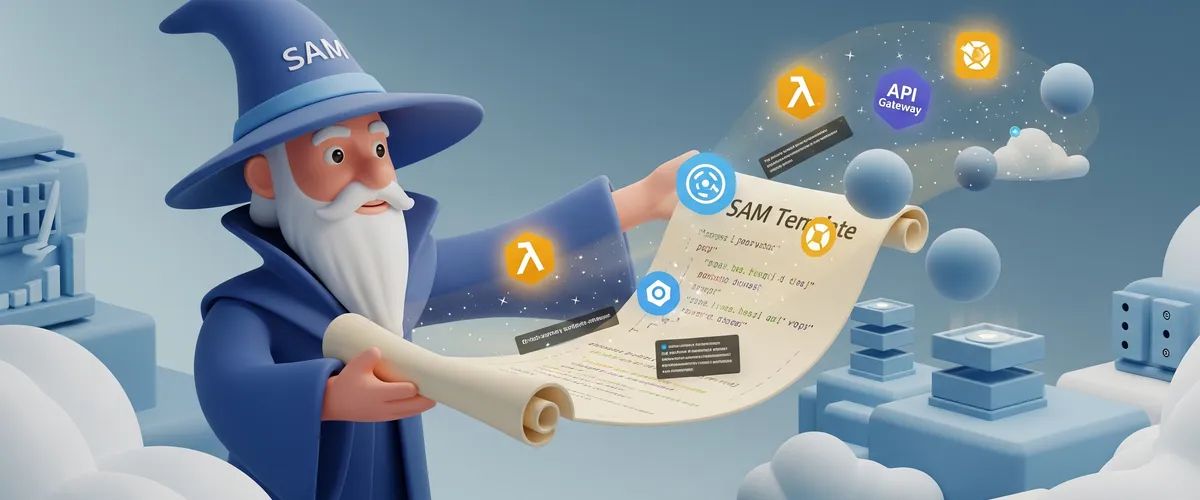
AWS SAM (Serverless Application Model) extends AWS CloudFormation with a simpler syntax for defining and deploying serverless applications. SAM templates let you define and deploy your serverless functions, APIs, and event sources without managing CloudFormation’s full complexity directly.
Understanding AWS SAM
How serverless works
Serverless architecture lets you focus on writing code without worrying about server management or infrastructure provisioning. It’s built on AWS Lambda, which supports scalable, event-driven applications.
Meet AWS SAM
AWS Serverless Application Model (SAM) is an open-source framework that extends AWS CloudFormation. It provides a simplified syntax and set of tools specifically designed for building and deploying serverless applications.
SAM templates
Structure and syntax
SAM templates use YAML or JSON to define your serverless application’s resources, such as functions, APIs, and event sources. The template structure is concise, which makes it easy to read and maintain.
Defining serverless resources
With SAM templates, you can declare your AWS Lambda functions, their event sources, and associated permissions. You can also define REST APIs using Amazon API Gateway and configure their endpoints and methods.
Simpler deployment
SAM templates simplify the deployment process by automating the creation of necessary resources and handling dependencies. You can deploy your application using the SAM CLI (Command Line Interface) or integrate it into your CI/CD pipelines.
Working with SAM
Local development and testing
SAM CLI provides a local development environment where you can test and debug your serverless applications before deploying them to the cloud. You can iterate and debug faster because you are not waiting on a deploy to see the result.
Lambda Layers and packaging
SAM lets you use Lambda Layers to share common code and dependencies across multiple functions. It also simplifies the packaging process by automatically bundling your code and dependencies into deployment packages.
Integration with AWS services
SAM integrates with other AWS services, such as Amazon DynamoDB, Amazon S3, and Amazon SQS, letting you incorporate them into your serverless applications with less configuration. The template wires up the permissions and event mappings between them for you.
Best practices for SAM in application deployment
Modularity and reusability
Design your SAM templates with modularity in mind, creating reusable components and Lambda functions that can be shared across multiple applications. That keeps things consistent and cuts duplicated code.
Security and access control
Implement secure practices by configuring IAM (Identity and Access Management) roles and policies for your serverless functions and APIs. Limit permissions to only what is required and implement encryption for sensitive data.
Monitoring and observability
Use AWS CloudWatch to see how your serverless applications perform and behave. Configure logging and monitoring metrics for visibility so you can troubleshoot issues efficiently.
Conclusion
AWS SAM simplifies the deployment of serverless applications. With SAM templates, you can define functions, APIs, and event sources without managing every CloudFormation detail by hand.
References
- AWS Serverless Application Model (SAM) Developer Guide, https://docs.aws.amazon.com/serverless-application-model/latest/developerguide/what-is-sam.html
- AWS SAM CLI Command Reference, https://docs.aws.amazon.com/serverless-application-model/latest/developerguide/sam-cli-command-reference.html
- AWS Lambda Developer Guide, https://docs.aws.amazon.com/lambda/latest/dg/welcome.html
- Amazon API Gateway Developer Guide, https://docs.aws.amazon.com/apigateway/latest/developerguide/welcome.html
- What is Serverless Computing? - AWS, https://aws.amazon.com/serverless/
- AWS CloudFormation User Guide, https://docs.aws.amazon.com/AWSCloudFormation/latest/UserGuide/Welcome.html
- AWS SAM Templates - AWS Documentation, https://docs.aws.amazon.com/serverless-application-model/latest/developerguide/sam-specification-template-anatomy.html
- Using Lambda Layers - AWS Lambda, https://docs.aws.amazon.com/lambda/latest/dg/configuration-layers.html
- Security Best Practices for AWS Lambda, https://docs.aws.amazon.com/lambda/latest/dg/best-practices-security.html
- Monitoring and Observability for Serverless Applications on AWS, https://aws.amazon.com/cloudops/monitoring-and-observability/
- AWS SAM GitHub Repository (for examples and issues.), https://github.com/aws/aws-sam-cli
- AWS CloudWatch User Guide, https://docs.aws.amazon.com/AmazonCloudWatch/latest/monitoring/WhatIsCloudWatch.html