GitOps at Scale: ArgoCD, Flux & Multi-Cluster Deployments
GitOps at Scale: ArgoCD, Flux & Multi-Cluster Deployments
Up to 20 questions, shuffled on every run
Welcome to the GitOps at Scale Quiz! As organizations grow, managing multiple Kubernetes clusters with GitOps becomes an important skill. This quiz will test your understanding of how to architect, deploy, and troubleshoot GitOps workflows using ArgoCD and Flux v2 in multi-cluster environments. Good luck!
Answer key and explanations20 questions
The quiz above draws 20 questions at random from these 27, so a second attempt will not be the same run. Everything in the pool is listed here.
What is the primary advantage of a push-based deployment model in a multi-cluster ArgoCD setup?
AnswerCentralized controller orchestrates and pushes state to target clusters
What is the primary purpose of an ArgoCD ApplicationSet resource?
AnswerTo dynamically generate multiple Applications from templates and generators
In GitOps multi-cluster architecture, what distinguishes hub-spoke from mesh topology?
AnswerHub-spoke uses a central management cluster; mesh uses peer-to-peer syncing
What is the primary benefit of the Flux v2 pull-based model for multi-cluster deployments?
AnswerEnhanced cluster autonomy reduces the impact of central controller failure
How does GitOps maintain configuration consistency across disparate clusters?
AnswerGit serves as the authoritative source for the declared system state
What does an "OutOfSync" status indicate in an ArgoCD multi-cluster deployment?
AnswerActual cluster state deviates from the desired state defined in Git
Which approach is recommended for managing secrets in a scaled GitOps workflow?
AnswerInject secrets at runtime using External Secrets or Sealed Secrets
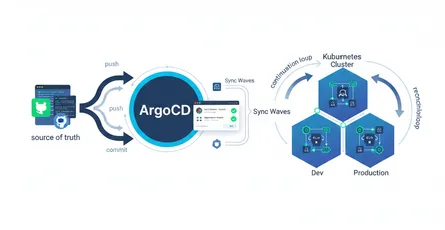
In GitOps, what is a "sync wave" and why is it used?
AnswerA mechanism to order the deployment of resources during reconciliation
What is an ApplicationSet matrix generator used for?
AnswerCombining multiple generators to create a product of configurations
How is progressive delivery integrated with multi-cluster GitOps?
AnswerTargeting a subset of clusters for initial rollout before full release
What is the difference between Flux HelmRelease and ArgoCD Helm integration?
AnswerFlux uses a declarative CRD; ArgoCD treats Helm as a template engine
How should you troubleshoot a cluster stuck "OutOfSync" in a multi-cluster setup?
AnswerVerify network paths, Git access, and controller reconciliation logs
What is a "cluster secret" in the context of a central GitOps hub?
AnswerStored credentials that allow the hub to access remote cluster APIs
What is a primary trade-off when choosing a push-based over a pull-based model?
AnswerPush offers better central control; pull offers higher local resilience
How are environment-specific settings managed in a DRY GitOps workflow?
AnswerUsing Kustomize overlays or ApplicationSet generators for variations
What is a "health check" in a multi-cluster GitOps controller?
AnswerAssessment of whether resources are functioning as declared in Git
In Flux v2, what is the role of a Kustomization resource?
AnswerDefining the path, interval, and strategy for applying Git manifests
Why are webhooks important in a multi-cluster GitOps environment?
AnswerThey trigger immediate reconciliation when a Git change is detected
When would you prefer Flux v2 over ArgoCD for multi-cluster use?
AnswerWhen requiring high cluster autonomy and native Helm CRD support
How is RBAC consistency maintained across multiple GitOps clusters?
AnswerBy defining RBAC manifests in Git and syncing them like applications
Which metrics matter most for monitoring GitOps health at scale?
AnswerReconciliation success rate, sync latency, and resource drift detection
How does GitOps facilitate disaster recovery for a failed cluster?
AnswerConnecting a new cluster to the existing Git repo restores state
What is "drift" in the context of GitOps multi-cluster management?
AnswerThe discrepancy between the live cluster state and the Git repo
How are feature flags managed in a multi-cluster GitOps workflow?
AnswerUsing external flag providers or Git-based configuration toggles
What is "cluster context" and why does it matter for GitOps?
AnswerThe identifier used by controllers to target specific cluster APIs
What is the standard approach for region-specific settings in GitOps?
AnswerInjecting per-cluster parameters via Kustomize or Helm values
How does observability help identify GitOps reconciliation failures?
AnswerBy correlating sync events with application health and error logs