Kubernetes Advanced
Advanced Kubernetes terms covering scheduling, networking, storage, security, extensibility, and workloads for platform engineers.
This glossary covers the advanced Kubernetes terminology platform engineers rely on: scheduling, networking, storage, security, extensibility, and the workload controllers that keep applications running at scale.
No terms found
Try adjusting your search query
Extensibility
6
CRD (Custom Resource Definition)
A way to teach the Kubernetes API a new object type without recompiling anything. Once registered, your custom resource is managed with kubectl just like a built-in one.
Example
Operator
An application-specific controller that encodes human operational knowledge to manage a complex workload, such as a database. It pairs one or more CRDs with a controller that acts on them.
Custom Controller
A control loop that watches resources and works to drive the actual state toward the desired state. Every operator is built around one or more custom controllers.
Reconciliation Loop
The continuous cycle a controller runs to compare desired state against observed state and take corrective action. It is the core pattern that makes Kubernetes self-healing.
Finalizer
A key on a resource that blocks deletion until a controller performs cleanup, such as releasing external resources. The object stays in a terminating state until the finalizer is removed.
Informer
A client-side cache and event mechanism that controllers use to watch resources efficiently. It avoids hammering the API server by caching objects and delivering change events.
Networking
6
CNI (Container Network Interface)
The plugin standard Kubernetes uses to wire pods into the cluster network. Plugins like Calico, Cilium, and Flannel implement CNI to assign pod IPs and enforce connectivity.
NetworkPolicy
A resource that controls which pods can talk to which, acting as a firewall at the pod level. By default all traffic is allowed; a policy switches the selected pods to deny-by-default for the directions it covers.
Example
kube-proxy
The node agent that programs the network rules making Service virtual IPs work. It uses iptables or IPVS to load-balance traffic across the pods behind a Service.
Ingress Controller
A pod that watches Ingress resources and configures a reverse proxy such as NGINX or Envoy to route external HTTP traffic to Services. The Ingress object is just rules; the controller does the work.
Service Mesh
An infrastructure layer, often built on sidecar proxies, that handles service-to-service traffic with features like mutual TLS, retries, and fine-grained observability. Istio and Linkerd are common examples.
CoreDNS
The in-cluster DNS server that resolves Service and pod names to their cluster IPs. It is what lets a pod reach another service by name instead of a hardcoded address.
Scheduling
8
Scheduler (kube-scheduler)
The control-plane component that watches for unscheduled pods and picks a node for each one based on resource requests, constraints, and priorities. It only decides placement; the kubelet on the chosen node actually runs the pod.
Taint
A mark placed on a node that repels pods unless they explicitly tolerate it. Taints let you reserve nodes for specific workloads, such as GPU jobs or system components.
Code Snippet
# Taint a node so only tolerant pods land on itkubectl taint nodes node1 gpu=true:NoScheduleToleration
A pod-level setting that allows the pod to be scheduled onto nodes carrying a matching taint. A toleration permits placement but does not force it.
Node Affinity
Rules that attract pods to nodes with matching labels, either as a hard requirement or a soft preference. It is the modern, expressive replacement for the older nodeSelector field.
Example
Pod Affinity and Anti-Affinity
Rules that place pods near or away from other pods based on labels. Anti-affinity is commonly used to spread replicas across nodes so one node failure does not take down the whole service.
Topology Spread Constraints
A policy that evenly distributes pods across failure domains like zones or nodes to limit the blast radius of any single failure. It controls how skewed the spread is allowed to become.
Priority Class
A named priority value assigned to pods so the scheduler knows which pods matter most. Higher-priority pods can preempt lower-priority ones when the cluster is short on resources.
Preemption
The act of evicting lower-priority pods to make room for a pending higher-priority pod that cannot otherwise be scheduled. It keeps critical workloads running under contention.
Security
6
RBAC (Role-Based Access Control)
The authorization system that grants permissions through Roles and RoleBindings. It decides which users and service accounts can perform which actions on which resources.
Code Snippet
# Check whether a service account may list podskubectl auth can-i list pods --as=system:serviceaccount:dev:appRole and ClusterRole
Objects that define a set of allowed actions on resources. A Role is scoped to a single namespace, while a ClusterRole applies cluster-wide or to non-namespaced resources.
Service Account
An identity used by pods to authenticate to the Kubernetes API and other services. Each pod runs under a service account whose permissions are set through RBAC.
Admission Controller
A plugin that intercepts requests to the API server after authentication but before persistence, and can validate or mutate them. It is how policies like resource limits or image rules are enforced.
Pod Security Standards
A set of predefined security profiles, Privileged, Baseline, and Restricted, that constrain what pods may do. They replace the deprecated PodSecurityPolicy and are enforced per namespace.
Webhook (Admission Webhook)
An external HTTP callback the API server invokes to validate or mutate resources dynamically. Validating webhooks accept or reject objects; mutating webhooks can change them before they are stored.
Storage
6
PersistentVolume (PV)
A cluster-level piece of storage provisioned by an administrator or dynamically by a StorageClass. It exists independently of any pod, so data survives pod restarts.
PersistentVolumeClaim (PVC)
A request for storage made by a pod, specifying size and access mode. Kubernetes binds the claim to a matching PersistentVolume, decoupling apps from the underlying storage details.
StorageClass
A template that describes a type of storage and how to provision it on demand. Referencing a StorageClass in a claim triggers dynamic provisioning instead of pre-creating volumes by hand.
Code Snippet
# A claim that dynamically provisions a fast SSD volumespec: storageClassName: fast-ssd accessModes: ['ReadWriteOnce'] resources: requests: storage: 20GiCSI (Container Storage Interface)
The standard plugin interface that lets storage vendors expose their systems to Kubernetes without changing core code. It is the storage equivalent of what CNI does for networking.
Dynamic Provisioning
The automatic creation of a PersistentVolume when a claim asks for a StorageClass, so no volume has to be pre-created. It turns storage into an on-demand resource.
Access Mode
A property that defines how a volume can be mounted, such as ReadWriteOnce for one node, ReadOnlyMany, or ReadWriteMany across many nodes. Not every storage backend supports every mode.
Workloads
7
StatefulSet
A workload controller for stateful apps that gives each pod a stable identity and its own persistent storage. Pods are created and scaled in a predictable, ordered sequence.
Example
DaemonSet
A controller that ensures a copy of a pod runs on every node, or on a selected subset. It is the standard way to deploy node-level agents like log collectors and monitoring daemons.
HPA (Horizontal Pod Autoscaler)
A controller that adds or removes pod replicas based on observed metrics like CPU, memory, or custom values. It scales out under load and back in when demand drops.
Code Snippet
# Autoscale a deployment between 2 and 10 pods at 70% CPUkubectl autoscale deployment web --min=2 --max=10 --cpu-percent=70VPA (Vertical Pod Autoscaler)
A controller that recommends or automatically sets the CPU and memory requests of pods based on real usage. It right-sizes pods rather than changing their count.
PodDisruptionBudget (PDB)
A policy that limits how many pods of an application can be down at once during voluntary disruptions like node drains. It protects availability while allowing routine maintenance.
Init Container
A container that runs to completion before the app containers in a pod start. It handles setup work such as waiting for a dependency or fetching configuration.
Sidecar Container
A helper container that runs alongside the main app container in the same pod, sharing its network and storage. Common uses include proxies, log shippers, and secret refreshers.
Comments
Was this useful?
Continue on this topic
The same subject, covered a different way from the glossary above.
 Article
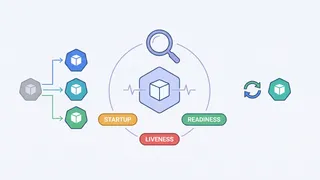
Kubernetes Health Probes: Building Self-Healing Applications
How Kubernetes liveness, readiness, and startup probes turn your application state into signals the control plane acts on, the misconfigurations that cause cascading outages, and how to wire zero-downtime rollouts with readiness gates and preStop drains.
 Case study
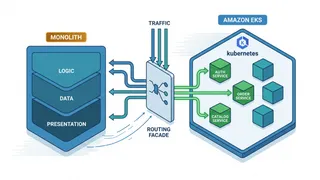
Migrating a Monolith to Kubernetes Without a Big-Bang Cutover
Using the strangler-fig pattern to move a large monolith onto EKS service by service, with a routing facade, gradual traffic shifting, and a rollback at every step.
 Dev tip
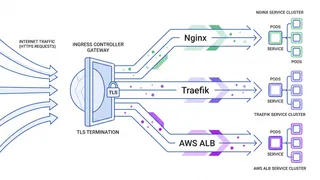
Kubernetes Ingress Controllers Explained: Nginx, Traefik, and AWS ALB Compared
A practical comparison of the most widely used Kubernetes Ingress controllers. You will learn how Nginx, Traefik, and the AWS Load Balancer Controller handle routing, TLS, and more, plus how to pick the right one for your setup.
 Quiz
QuizIstio: Service Mesh Fundamentals
Master the fundamentals of Service Mesh, traffic routing, and mutual TLS security within a Kubernetes environment.
You might also enjoy
More posts on similar topics
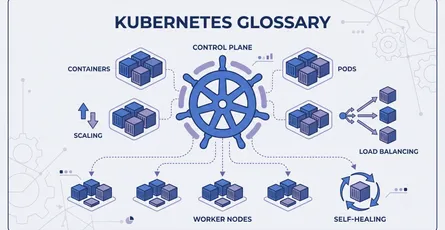
Containers & Kubernetes
This glossary covers essential terms for working with containers and Kubernetes: building Docker images, and managing workloads, networking, storage, scaling, and security in a Kubernetes cluster.

DevOps Basics
This glossary covers foundational terms used in DevOps and cloud engineering, spanning containerization, orchestration, infrastructure as code, CI/CD pipelines, observability, and deployment strategie
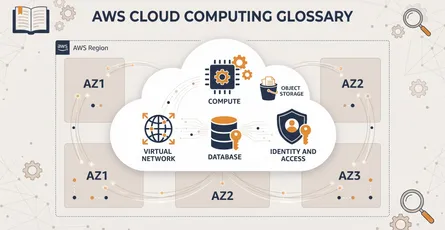
Cloud Computing on AWS
This glossary covers the essential Amazon Web Services terms every cloud engineer and architect should know: compute, storage, networking, databases, and the identity controls that keep it all secure.
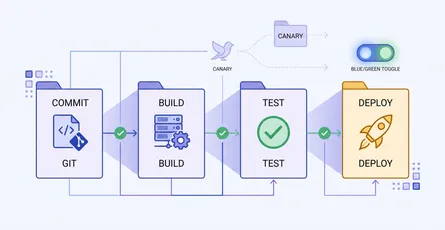
CI/CD & Automation
A quick-reference glossary of the terms you meet when automating builds, tests, and deployments: pipeline anatomy, test gates, and release strategies like canary and blue-green.
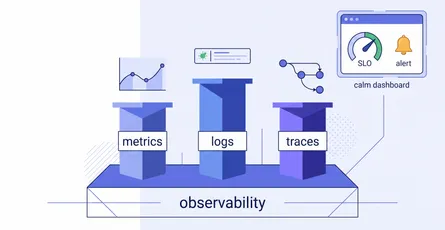
Observability & Monitoring
A quick-reference glossary for making sense of system health: the three pillars (metrics, logs, traces), the reliability vocabulary (SLI, SLO, error budget, burn rate), how good alerting works, and th
Databases & SQL
Most confusion about SQL is vocabulary rather than syntax. People know how to write a join and still get caught by a LEFT JOIN that quietly behaves like an INNER JOIN, because nobody explained that a
6 related posts